

No siding material can guarantee that a home will survive a wildfire. But choosing noncombustible siding, installing it correctly, and reducing other vulnerabilities around your home can significantly lower the chance of ignition.
Siding As Part of a Bigger System
Homes ignite in several ways during a wildfire. Wind-blown embers can enter openings or collect against exterior materials, radiant heat can break windows or ignite nearby combustibles, and flames can spread from vegetation, fences, decks, sheds, or neighboring structures.
NIST’s Camp Fire Case Study found that homes often ignite through multiple pathways, not a single weak point. That’s why the most effective approach is reducing vulnerabilities across the entire home rather than relying on one product alone.
Choosing the Right Siding for Your Home
When comparing siding options, look for manufacturer fire-test information, confirm the product meets local code requirements, and consider the complete wall assembly, not just the siding.
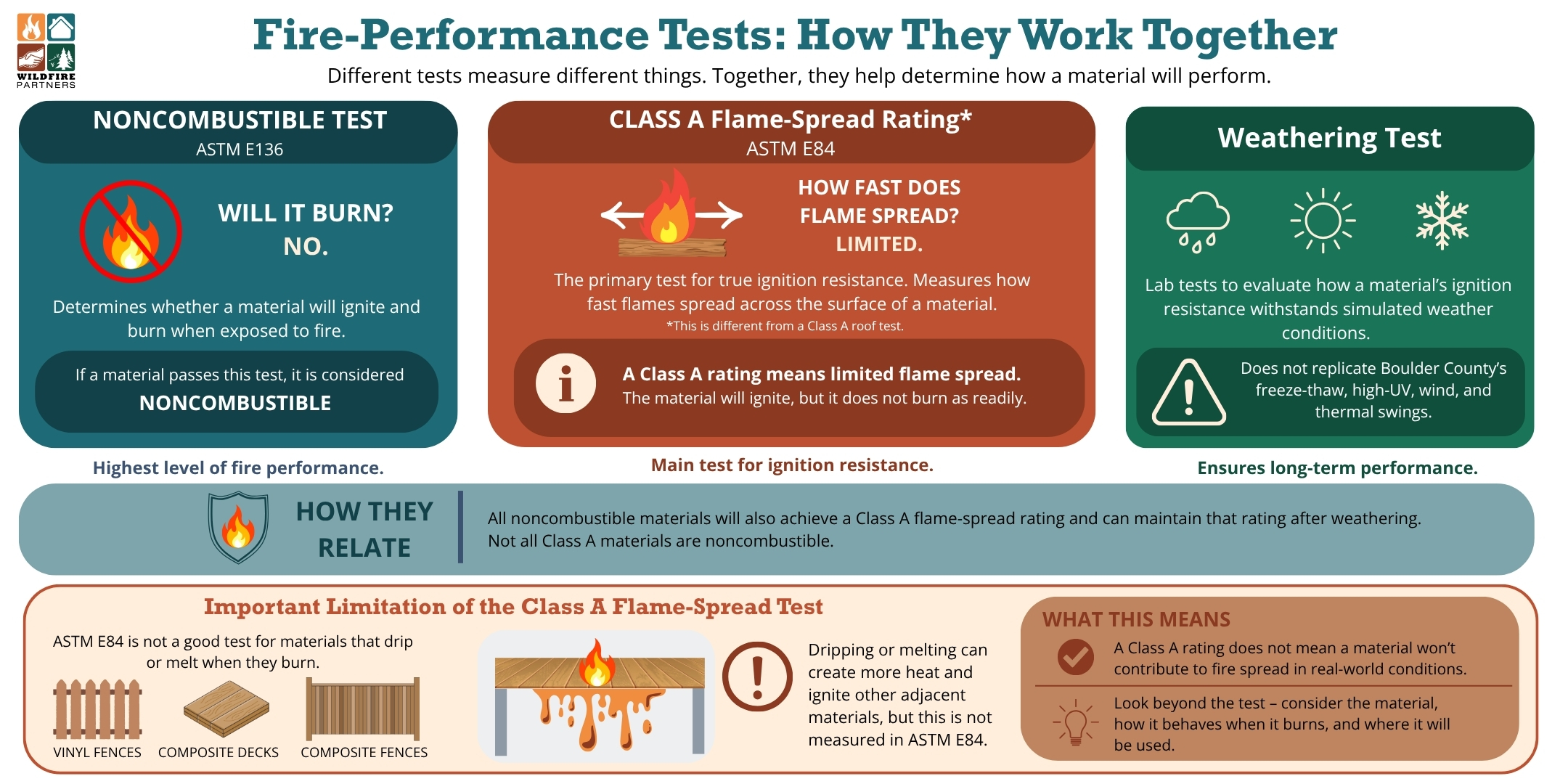
It’s also helpful to understand common fire-performance terms. A material is considered noncombustible when, in the form used, it will not ignite and burn when exposed to fire. ASTM E136 is one test used to establish that classification. A Class A flame-spread rating, which differs from a Class A roof test, describes limited flame spread across a material’s surface in a standardized test. It tests for ignition resistance and does not mean the material is noncombustible.
Noncombustible and ignition-resistant are not the same. Noncombustible materials do not ignite or burn under the applicable test conditions. Ignition-resistant materials may be combustible, but they are designed and tested to better resist ignition and flame spread — including required weathering evaluations. All noncombustible materials are ignition-resistant, but not all ignition-resistant materials are noncombustible.
Neither classification, by itself, predicts how a complete wall or the home as a whole, will perform during a wildfire.
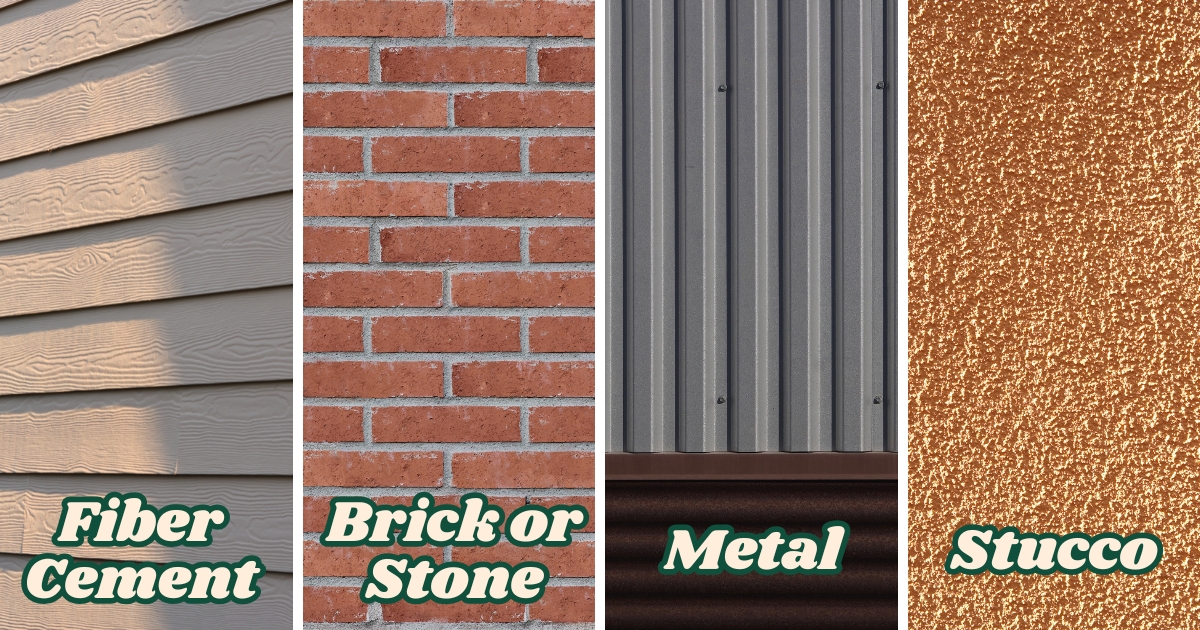
Types of Noncombustible Siding
Fiber Cement
Fiber-cement siding is commonly made from cement, sand, and cellulose fibers. Many products are listed or tested as noncombustible; ask the manufacturer for current documentation for the specific product.
Available in panels, lap siding, and shingle-style profiles, fiber cement can mimic wood siding or shakes while offering greater resistance to ignition.
Metal Siding
Steel and aluminum siding do not readily ignite, so they can reduce the amount of combustible material on the outside of a home. Metal siding is available in a range of colors and profiles, including wood-look options.
When comparing metal products, focus on the complete wall design and the manufacturer’s installation instructions. Do not assume that a thicker steel panel has a better wildfire rating unless the manufacturer provides test information that supports that claim.
Brick and Stone
Brick and stone are noncombustible materials with good fire-resistance characteristics. On most homes, however, brick and stone are installed as a veneer over a wood-framed wall rather than as a solid masonry wall.
Although the veneer will not ignite, heat and embers can still reach vulnerable parts of the wall assembly through gaps, joints, penetrations, and other openings.
Stucco
Traditional cement plaster, often called three-coat stucco, is a cement-based exterior finish. It has strong fire-resistance characteristics when it is properly installed as part of a complete wall assembly.
It is important to understand that not every product called “stucco” is the same.
EIFS, or Exterior Insulation and Finish System, is sometimes called synthetic stucco. It typically has a thin reinforced finish over an insulation layer, often made from foam plastic. EIFS with foam-plastic insulation is combustible and is not recommended.
Fire-Retardant Coatings
Fire-retardant coatings are sometimes marketed as a way to protect combustible siding from wildfire. However, research from the Insurance Institute for Business & Home Safety (IBHS) found that most tested coatings lost their fire resistance within a few months of outdoor exposure, and none provided meaningful protection compared with untreated wood after three months.
For homeowners replacing siding, choosing an inherently noncombustible material is a more reliable approach than relying on a fire-retardant coating. Learn more about the research on fire-retardant coatings in Do Fire-Retardant Coatings Really Protect Homes from Wildfire? What the Science Says.
Installation Considerations
Even the best siding performs poorly if it’s installed with gaps or openings that allow embers to reach combustible materials. Follow the manufacturer’s installation requirements for flashing, fasteners, ground clearance, and sealing around windows, doors, vents, and other penetrations.
Replacing siding can also be an opportunity to improve your home’s air barrier, reducing the amount of wildfire smoke and unwanted outside air that enters through leaks. When paired with filtered mechanical ventilation, a tighter building enclosure can improve both wildfire smoke resilience and everyday comfort.
Beyond the Siding
Noncombustible siding is a valuable upgrade, but it works best as part of a whole-home approach. As you plan a siding project, also address combustible materials within the first five feet of the home, as well as vents, roof edges, windows, and gaps where embers can enter. The goal is not to make a home fireproof, but to reduce as many ignition pathways as possible.
Comments are closed.