

Colorado’s beloved aspen trees may do more than brighten the mountains each fall — they may also help slow the spread of wildfires.
A recent study on aspen trees and wildfires found that landscapes with healthy aspen stands were less likely to carry fast-moving, high intensity fires, even during extreme weather conditions.
Why Aspens Matter
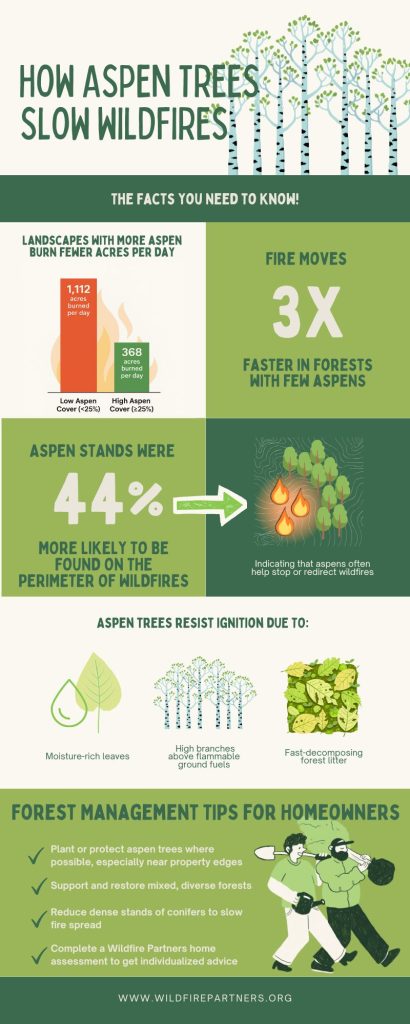
The researchers found that landscapes with more aspen cover saw less area burned each day and experienced slower rates of fire spread during a wildfire. In locations where aspen made up more than 25% of the vegetation, wildfires advanced at roughly one-third the speed seen in areas with minimal aspen. This effect remained strong even during hot, dry, and windy conditions that typically promote rapid fire growth.
The study also found that aspen stands were more common along the edges of wildfire-burned areas than within the interior, suggesting that aspens may help slow or stop a wildfire’s forward movement. These findings were especially noticeable in the late summer, when aspen’s moisture-rich leaves and unique branch structure make them less flammable than conifer species like pine or spruce.
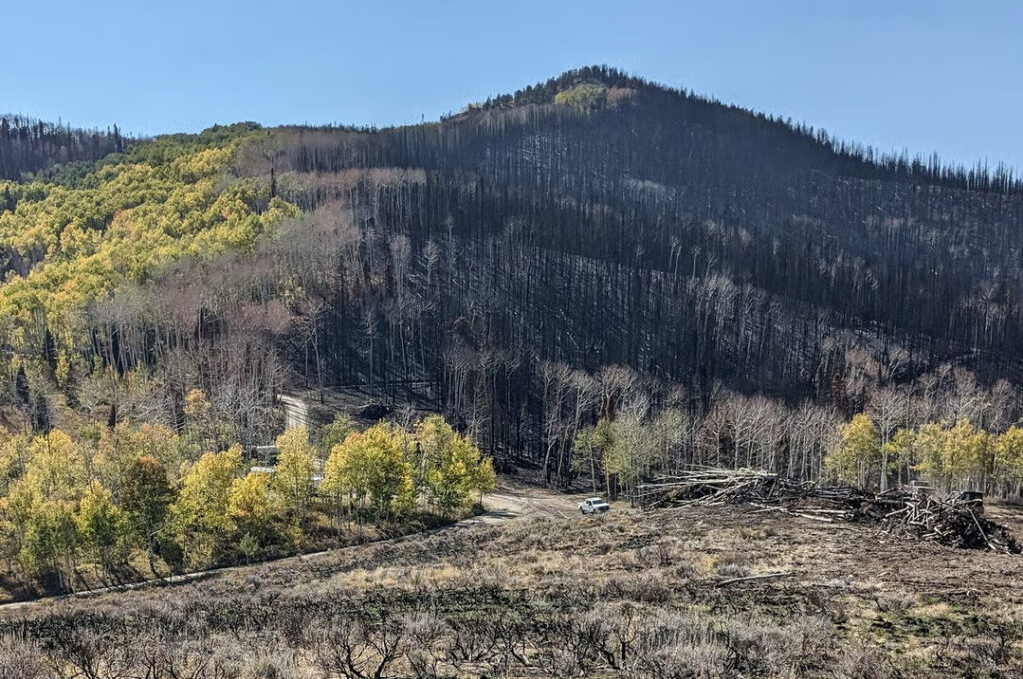
An aspen grove stand at the perimeter of the 2023 Lowline Fire near Gunnison. The aspens can be seen primarily on the left of the photo. Photo courtesy of Jonathan Coop.
Nature’s Built-In Firebreaks
Aspen trees behave differently from conifer species for several reasons:
- Their leaves and bark hold more moisture, making them harder to ignite.
- They have higher canopies that are less dense that help limit crown fires.
- The forest floor under aspens decomposes faster so there’s less dry fuel to feed a fire.
- Chemical differences in aspen can also contribute to lower flammability, which helps impede fire progression.
In contrast to dense stands of lodgepole pine or Douglas-fir, which can carry fire rapidly through dry needles and closely packed trees, aspen groves interrupt those fuel pathways. The study found that aspen often acted like natural speed bumps for fire, reducing intensity and creating safer conditions for firefighters and nearby communities.
Lessons from the Cold Springs Fire
These research findings reflect what Wildfire Partners and Boulder County homeowners have seen firsthand. During the 2016 Cold Springs Fire near Nederland, some homes surrounded by healthier, more diverse forests with patches of aspen, experienced noticeably different fire behavior than nearby properties with dense conifer stands.
One landowner spent years thinning an overgrown lodgepole pine forest, encouraging aspen regeneration, and hardening their home. When the Cold Springs Fire moved through the area, flames that had been advancing rapidly through dense conifers slowed and changed behavior as they reached the aspen patches. While no single action or tree species “saved” the home, Wildfire Partners’ records show that sustained mitigation, combined with a more open forest structure and a strong aspen component, helped improve the odds when fire arrived, even as neighboring homes were lost.
What This Means for Homeowners
For Boulder County homeowners, the study’s findings reinforce several practical steps:
- Maintain defensible space within the first 100 feet of your home by reducing dense conifers and ladder fuels that can carry fire into the canopy or toward structures.
- Protect and, where appropriate, encourage aspen stands beyond the first five feet of the home as part of a more diverse forest.
- Work with Wildfire Partners to combine home hardening with defensible space and smart forest management. Sign up for an individual home assessment to discuss your options.
While no single tree species can stop a wildfire, aspen stands play an important role in how wildfire moves across forests. This research adds to the growing body of evidence that diverse, healthy forests are key to reducing wildfire risk.
How Aspen Trees Slow Wildfires Infographic
View the infographic below for information on how aspen trees slow wildfires.
Comments are closed.